Minimum Order Quantity: What to Do When a Supplier Wants More
Minimum order quantity: check the real minimum, test a smaller first order, or compare the cost of holding extra stock before you commit.
By Ultimate Inventory Tracker by Cosmo Suite · Editorial policy
Published · 8 min read

A supplier's minimum can turn a small restock into a much larger purchase. The number may apply to units, order value, or a pack size, and those rules lead to different decisions. Before you agree, find out what the minimum counts and whether the extra stock has a clear use.
In Short
- Ask what the minimum counts: units, dollars, cases, colours, or sizes.
- Compare the minimum with the amount you can use before it gets old or takes over storage.
- Ask about a sample, a smaller first order, a split delivery, or a different pack.
- If the terms do not fit, compare another supplier before committing.
What a minimum order quantity means
Minimum order quantity (MOQ) is the smallest quantity a supplier will accept in one order. Some suppliers set a unit minimum; others set a minimum order value or require full packs. The term alone does not tell you how many pieces you must buy, so ask for the rule in writing. Shopify's guide, published 27 May 2026, describes unit and value minimums, plus rules such as case multiples and per-colour quantities.
| Supplier's rule | What to ask | Example only |
|---|---|---|
| Unit minimum | Is the count per item or across the whole order? | At least 24 jars |
| Order-value minimum | Which items count toward the threshold? | At least $240 before delivery |
| Pack multiple | Must the order use full cases or multiples? | Cases of 12 |
| Variant minimum | Does each colour or size have its own floor? | 12 of each colour |
Shopify's examples of case multiples and per-variant MOQs show why the exact wording matters: one supplier may count the whole order, while another sets a floor for each colour or size. Use the supplier's own written terms to settle which applies.
When the minimum is value-based, divide the order minimum by the quoted unit price to estimate how many pieces it implies. A $240 minimum divided by $8 per piece is 30 pieces. The supplier may still require case multiples, and shipping or other charges can change the amount you pay. Confirm the quote before treating the arithmetic as an order total. This division only converts a value floor into an estimated unit count; it does not tell you how much stock your shop needs.
MOQ and economic order quantity (EOQ) answer different questions. MOQ is the supplier's floor; EOQ is the amount a buyer's cost calculation suggests ordering. Shopify explains the distinction. For a small shop, the useful question is what to do when the supplier's floor is larger than your likely use.
Start with the amount you can use
Before answering a supplier, estimate how much of the item you can use and where it will sit. Check stock on hand, orders already placed, recent use, shelf life, and storage space. This is a practical stock check, not a demand forecast: if your records are thin, keep the estimate cautious and treat the first order as a test.
For a candle maker, the question might be whether a carton of jars will cover the next few batches without filling the workroom. For a seller buying seasonal packaging, ask whether the remaining pieces will still suit the next season. A lower per-piece price does not settle either question. The unused quantity still needs a place and a future use.
Separate stock into what is ready to use, what is already on order, and what you expect to use before another delivery could arrive. Do not count the same item twice because it appears in a shelf count and a purchase note. If your supplier has a long lead time, keep that period visible in the decision, but do not assume an estimated arrival date is guaranteed.
For a perishable supply, check the date you can use it by and the quantity each batch consumes. For a material that does not expire, check whether the colour, size, packaging, or product design may change. This is where the “good deal” can turn into an awkward box: it may be usable in theory but wrong for the items you make next.
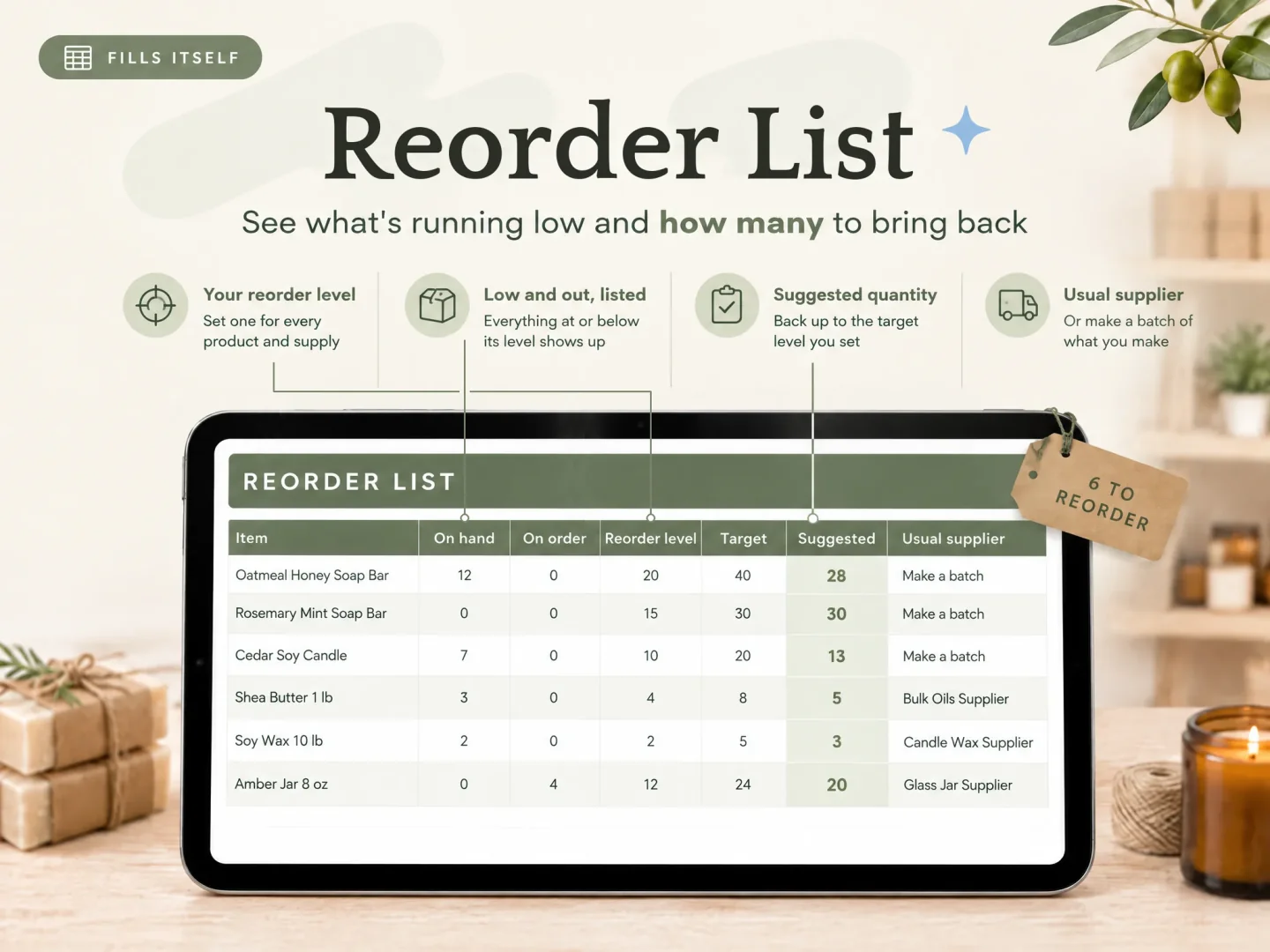
Write down four quantities before you decide: what is on hand, what is already on order, what you expect to use before the next delivery, and what the supplier requires. The gap between your need and the MOQ is the amount you must explain, store, or avoid buying.
Supplier minimum: what to try when it is too high
When a supplier's MOQ is larger than your likely use, first find out what creates the floor. A production setup, an upstream material limit, or a carton size calls for a different request. Freightos's ordering guide recommends asking why the minimum applies; it also covers checking samples and agreeing terms in writing. These are options to discuss, not promises that a supplier will accept them.
| Your constraint | Ask the supplier | Check before agreeing |
|---|---|---|
| You need fewer pieces | Can I place a smaller trial order, perhaps at another unit price? | Total price and quality of the smaller run |
| The minimum is a case pack | Can I mix items in a case or buy a broken case? | Pack sizes and handling charges |
| A material or colour sets the floor | Can the same material serve more than one product? | Whether the material actually fits each product |
| You can use the stock, but not store it now | Can we agree to one purchase with deliveries in stages? | Dates, storage responsibility, payment, and cancellation terms |
| No term fits your shop | Is there a supplier with a smaller pack or trial quantity? | Quality, lead time, and the complete delivered cost |
Ask one specific question at a time. “Can you do less?” gives the supplier little to work with. “Your order page says 48 jars per colour. Could I test 12 in one colour at a higher unit price?” names the constraint and a possible trade. It may be declined; you then have a clearer basis for comparing alternatives.
If the supplier says no, ask what would need to change. Could a different colour or finish use the standard pack? Is the minimum tied to the component rather than the finished item? Could delivery happen in two agreed batches after one purchase? A clear no is useful too: you can stop planning around an option the supplier does not offer. Do not rely on a verbal promise about later delivery or a future lower minimum. Put quantities, dates, price, and payment terms in the written order confirmation. Freightos's ordering guide, updated 28 June 2026, also recommends written terms and checking a sample before confirming a purchase.
If a sample is available, check the material, size, finish, and packaging against what you need. Freightos advises buyers to review a sample before confirming an order. Keep the approved sample and the written product details together so a later delivery can be compared with what you accepted. The same guide lists order size, unit price, payment, delivery, and product specifications among the terms to settle. For a small order, the names and details may fit in an email confirmation, but you still want both sides to agree on the same quantity and dates.
MOQ: what to do when
Your next step depends on why the supplier set the minimum and how much extra stock you would hold. Use the table to choose a question that fits your order.
| Situation | Next step | Decision check |
|---|---|---|
| You can use the full amount soon | Compare unit price and delivered total | Does the quantity fit storage and timing? |
| You want to test quality or demand | Ask for a smaller first order or sample | Is the higher trial price acceptable? |
| The pack size is the obstacle | Ask about mixed or split packs | Does the supplier allow it in writing? |
| You could use the full amount over time | Ask about staged delivery | Who stores it, and when is payment due? |
| The amount still exceeds your needs | Compare another supplier | Are quality and lead time still suitable? |
Do not treat “the unit price is cheaper” as the whole calculation. Note the quantity, quoted price, delivery, and any storage or handling terms. Then compare that total commitment with the smaller option. If the supplier cannot provide a smaller order, the answer may be to wait until demand is clearer or choose a different source.
A maker's small-order example
Suppose a soap maker has 18 suitable jars in the studio and expects to use 12 for the next planned batch. A supplier quotes jars in cartons of 36. The maker does not need to buy immediately just because the carton price looks better. First, she asks whether mixed sizes are allowed and whether the supplier sells a smaller trial pack.
If neither option is available, she checks whether the remaining 24 jars have a use in other planned products and enough shelf space. If not, she compares a second supplier's pack and delivery terms. The counts here are illustrative; the useful step is recording the available stock and expected use before choosing a pack.
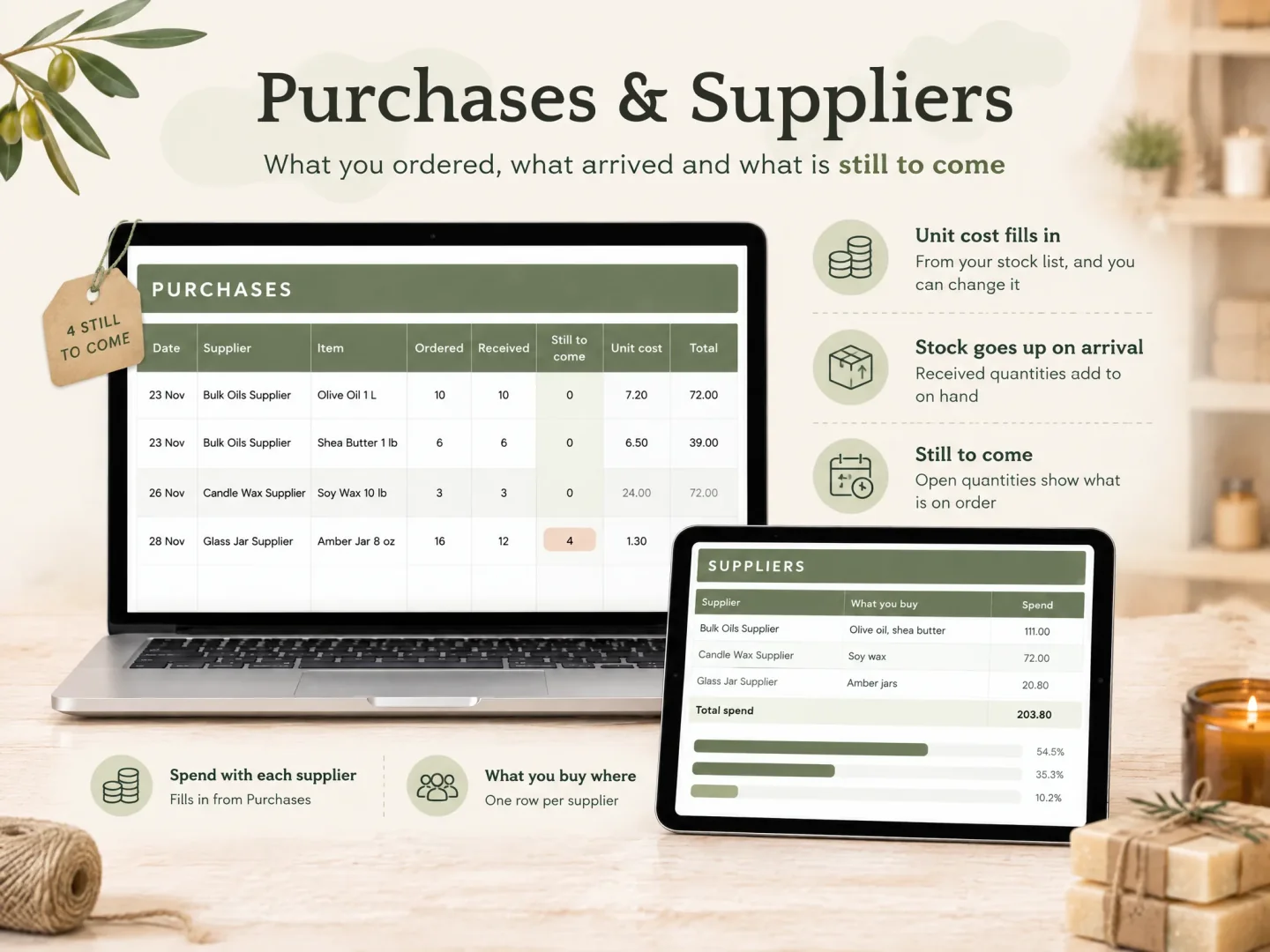
Once an order is placed, record the quantity ordered separately from the quantity received. Check the delivery against the order, then update the stock record for what arrived. That distinction helps when part of an order is delayed or short. A simple inventory list template can help organize item, unit, supplier, and quantity fields before you build a fuller movement log.
Keep the stock record useful
An MOQ decision does not end when a box arrives. Keep the item's unit consistent, record the purchase, and note the received quantity. When you use supplies in a batch or sell finished pieces, record that movement too. A cycle count routine can help you check a shelf against the quantity in your record when the two no longer agree.
The Ultimate Inventory Tracker (by Cosmo Suite: one Google Sheets and Excel file, 12 tabs, $9 once) includes Purchases, Products & Supplies, and a Reorder List. Its records update when you log entries. It does not connect to an online shop or till and does not scan barcodes; you log or paste each sale. It can help you see what was ordered and what is on hand, while the supplier's MOQ remains a term you must confirm with them. The Ultimate Inventory Tracker file details show the tabs and formats; the tracker contents and price are listed on the product page.
If you keep supplier terms in a separate note, include the minimum type, pack size, quoted price, date, and who confirmed it. A clear record makes the next reorder easier to compare, especially when the supplier changes its pack or lead time.
Sources and limits
Shopify's guide defines MOQ and describes unit, value, pack, and variant rules. Freightos's ordering guide discusses samples, supplier terms, and finding out why a minimum applies. Both pages were checked on 26 October 2026. Supplier terms vary, so ask each supplier to confirm the exact minimum, price, delivery timing, and payment conditions for your order. Ultimate Inventory Tracker is made by Cosmo Suite. The about page and editorial policy explain who publishes this site and how sources are checked; use the contact details there to send a correction.
Frequently asked questions
What does minimum order quantity mean?
Minimum order quantity (MOQ) is the smallest quantity a supplier will accept in one order. It may be a number of units, a total order value, or a case-pack rule. Ask which measure applies to the product and whether it applies per item, colour, or size.
How do I calculate a minimum order quantity from a minimum spend?
Divide the minimum spend by the quoted price per unit, then check how the supplier rounds or packs the order. For example, a $240 minimum at $8 per unit means 30 units before any shipping, tax, or other charges. Confirm the final amount with the supplier.
Can I ask a supplier to lower its MOQ?
Yes. Ask what sets the minimum and whether a smaller trial order is possible at a different unit price. A minimum may come from a production run, an upstream material, or a pack size, so the workable option depends on its cause.
Should a small shop accept a high MOQ for a lower unit price?
Only if the full quantity fits your expected use, storage, and available cash. A lower unit price does not make extra stock useful if it sits too long, expires, or becomes hard to store. Compare the full order and delivery terms before deciding.
What is the difference between MOQ and EOQ?
MOQ is the supplier's minimum order rule. Economic order quantity (EOQ) is the amount a buyer's cost calculation suggests ordering. If the EOQ is below the MOQ, the supplier's rule may leave you holding more stock than your own order plan calls for.
How can I keep track of stock bought under an MOQ?
Record the quantity ordered and received, then track what you use or sell. A spreadsheet can show the remaining stock and a reorder level, but it does not connect to a shop or till or scan barcodes. You must log or paste each sale.
